
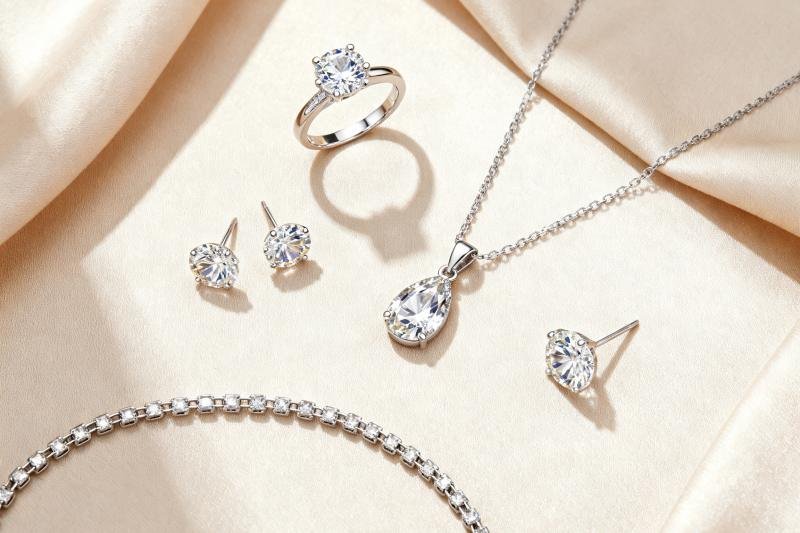
The global fine jewelry market has undergone a massive paradigm shift. As consumers increasingly demand ethical sourcing, exceptional brilliance, and unbeatable value, moissanite jewelry has emerged as an undisputed powerhouse. For jewelry brands, wholesalers, independent designers, and e-commerce entrepreneurs, understanding the backend of production is the ultimate competitive edge.
Whether you are looking to scale your private-label collection or design custom engagement rings, partnering with an experienced OEM & ODM manufacturer makes all the difference. With over 10 years of manufacturing expertise, a monthly capacity of 8,000+ pieces, and an independent gemstone cutting division, we have helped over 500+ global jewelry companies across 30+ countries bring exceptional pieces to life.
In this comprehensive guide, we take you behind the scenes of professional moissanite jewelry manufacturing—covering every vital stage from raw material selection to the final quality inspection.
1. Understanding Moissanite as a Manufacturing Material
Before diving into the production floor, it is crucial to understand why moissanite behaves the way it does during crafting.
-
Hardness: Moissanite rates 9.25 on the Mohs hardness scale, making it second only to diamond (10). This high durability allows it to withstand daily wear, making it an ideal choice for engagement rings, wedding bands, and statement hip-hop jewelry.
-
Optical Properties: With a refractive index of 2.65–2.69 (higher than a diamond’s 2.42), moissanite exhibits extraordinary “fire” and brilliance. However, this also means precision cutting is mandatory to manage light returns and prevent a “disco ball” effect.
-
Metal Compatibility: Moissanite pairs seamlessly with precious metals. Premium manufacturers utilize 9K, 10K, 14K, and 18K gold (yellow, white, and rose), 925 pure silver, and platinum.
2. Phase One: The Independent Gemstone Cutting Division
Unlike standard assembly-line factories that source pre-cut stones of variable quality, elite manufacturers operate an independent gemstone cutting division. This vertical integration ensures total control over brilliance, symmetry, and supply chain consistency.
Cutting & Faceting
The manufacturing journey begins with raw moissanite crystals. Master lapidaries analyze each rough stone for clarity, color grade (typically D-F colorless or near-colorless), and inclusion patterns to maximize yield and optical performance.
-
Precision Cuts: While round brilliant is the industry standard, modern consumers crave variety. Cutting divisions specialize in an array of shapes including Oval, Emerald, Radiant, Cushion, Asscher, Pear, and Marqius.
-
Heart & Arrow (H&A) Precision: For round stones, strict optical symmetry creates the coveted “Hearts and Arrows” pattern, ensuring optimal light reflection and maximum brilliance.
3. Phase Two: Design, CAD, and 3D Modeling (OEM/ODM)
Once the stones are polished to perfection, the physical creation of the jewelry piece begins in the design studio.
-
ODM (Original Design Manufacturing): Brands can choose from our extensive catalog of 8,000+ monthly styles, including classic solitaires, vintage halo engagement rings, tennis chains, Cuban links, and intricate pendants.
-
OEM (Original Equipment Manufacturing): Clients bring their custom sketches, mood boards, or CAD files. Our senior CAD engineers convert concepts into precise 3D digital renderings, calculating prong placements, metal weights, and structural integrity before any metal is cast.
4. Phase Three: Casting and Metal Shaping
With the CAD model approved, the physical jewelry takes form in the casting department.
-
Wax Printing & Investment Casting: High-resolution 3D printers create exact wax models of the jewelry piece. These wax trees are encased in plaster, melted out in a kiln, and replaced with molten precious metal—whether it is 14K gold, 925 silver, or platinum.
-
Initial Cleanup: The raw castings undergo filing, sanding, and structural deburring to ensure the silhouette matches the original design specifications flawlessly.
5. Phase Four: Expert Stone Setting
Stone setting is where engineering meets artistry. Because moissanite possesses a high refractive index, secure and precise setting is critical to showcase the stone while protecting it against impact.
-
Prong Setting: Commonly used for engagement rings and solitaires to maximize light entry.
-
Pave and Micro-Pave Setting: Essential for halo rings, bracelet bands, and hip-hop pendants, where dozens of tiny moissanite stones are set flush side-by-side under magnification.
-
Channel and Bezel Setting: Popular for sleek wedding bands and modern geometric collections, offering extra security and a smooth profile.
6. Phase Five: Precision Polishing & Electroplating
A jewelry piece is only as striking as its finish.
-
Multi-Stage Polishing: Pieces pass through coarse, medium, and fine polishing wheels—followed by magnetic pin polishing for intricate hollow spaces (such as heavy Cuban links)—to achieve a mirror-like finish.
-
Electroplating: For white gold or silver pieces, a micro-layer of rhodium is applied to enhance brightness, prevent tarnishing, and provide a hypoallergenic barrier. For yellow or rose gold pieces, specialized plating baths ensure rich, long-lasting color saturation.
7. Phase Six: Rigorous Quality Inspection (QC)
Before any batch leaves the factory floor, it must pass a strict multi-point Quality Control (QC) checklist. Our quality assurance protocol inspects:
-
Stone Security: Prong testing and pressure checks to ensure no loose stones.
-
Setting Symmetry: Alignment, spacing, and claw uniformity under 10x magnification.
-
Metal Integrity: Verification of metal purity stamps (e.g., 14K, 925) and absence of surface porosity or casting flaws.
-
Finish & Polish: Inspection for scratch-free reflective surfaces and smooth interior bands.
8. Typical Production Timeline & Supply Chain Efficiency
For e-commerce brands and wholesalers, lead time is everything. Partnering with an experienced Chinese OEM/ODM manufacturer streamlines your inventory cycles. A typical production schedule runs as follows:
-
CAD Design & Approval: 2 – 4 days
-
Sample Production: 7 – 10 days
-
Bulk Manufacturing (Batch Orders): 15 – 25 days (depending on complexity and order volume)
-
Global Logistics & Express Shipping: 3 – 7 days to major global hubs across 30+ countries.
Partner With Us For Your Next Moissanite Collection
Navigating the nuances of moissanite manufacturing requires a seasoned partner who understands both artisanal craftsmanship and scalable commercial production. Whether you are launching a line of sustainable engagement rings, luxury wedding bands, or statement hip-hop pieces in 9K, 14K, 18K gold, or 925 silver, our team is equipped to turn your vision into reality.
Ready to elevate your brand? Contact us today to discuss your custom OEM/ODM project, request product samples, or explore our extensive wholesale catalog.