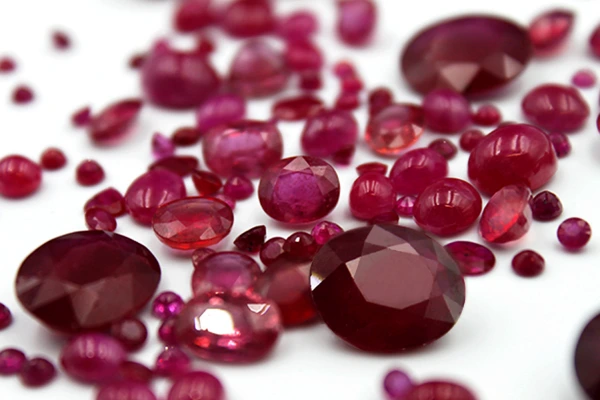
In high-volume B2B fine jewelry manufacturing and premium private-label sourcing, lab-created rubies have emerged as a high-margin, optically flawless alternative to dwindling, highly included natural corundum reserves. Synthesized via Czochralski pulled, flux growth, hydrothermal simulation, or Verneuil flame-fusion methods, lab-created rubies share identical chemical (Al2O3), physical, and optical attributes with natural rubies. However, because laboratory environments bypass geological disruptions, these stones feature high structural purity and an exceptionally rich concentration of chromium ions (Cr3+), which cause both its signature red hue and strong UV-fluorescence.
For jewelry brands, wholesale importers, and CAD designers working with premier production plants like AuGain Jewelry Co Ltd, mastering the specific interactions between synthetic crystal orientations and faceting layouts is critical. Unlike moissanite, which displays a refractive index of 2.65–2.69, ruby possesses a mid-to-high Refractive Index (RI) of 1.762 to 1.770, with a low Birefringence of 0.008 and an absolute Mohs Hardness of 9. This specific refractive window means that a ruby cut incorrectly will suffer from severe extinction (dark, lifeless zones where light leaks through the pavilion) or a completely washed-out hue. This comprehensive technical guide serves as your master ruby cut guide, containing a definitive ruby shapes list and an engineering framework on which ruby cut to choose to minimize structural wastage and unlock optimal saturation, luster, and fire.
Part 1: Crystallographic Physics: Pleochroism, Orientation, and Extinction
To properly evaluate any gemstone from a ruby shapes list, engineers must first understand the optical anisotropy of corundum. Ruby crystallizes in the trigonal crystal system, possessing a uni-axial negative optical character. This gives rise to a powerful physical phenomenon known as strong pleochroism—specifically, dichroism.
When light travels through a lab-grown ruby crystal, it splits into two distinct rays vibrating at right angles to one another:
The Ordinary Ray (o-ray): Displays a highly desirable, rich, velvety purplish-red (often referred to in luxury trade circles as “pigeon’s blood”).
The Extraordinary Ray (e-ray): Displays a noticeably less saturated, lighter orangey-red.
If a gemstone cutter slices raw lab-grown crystal boule haphazardly to maximize weight yield, the face-up table of the finished gemstone may sit parallel to the c-axis. This forces the buyer to look directly at a blend of orange and red, significantly cheapening the product’s perceived value. Premium manufacturers precisely orient the gemstone’s table facet strictly perpendicular to the c-axis (optic axis). This isolates the purplish-red ordinary ray face-up, ensuring the ruby exhibits the deepest, most uniform crimson saturation regardless of the geometric shape chosen.
Part 2: Comprehensive Ruby Shapes List & Technical Facet Configurations
The following matrix provides an engineer-level, exhaustive breakdown of the standard commercial ruby shapes list, analyzed through the lens of optical physics and light return mechanics.
1. The Oval Mixed Cut Shape
Standard Facet Count: 57 to 61 facets (typically 29 on the crown, 32 on the pavilion).
Ideal Length-to-Width (L/W) Ratio: 1.33 : 1.00 to 1.40 : 1.00.
Optical Profile: Maximal color concentration, high structural scintillation, and optimal mask-over of internal pleochroic variations.
The Oval Mixed Cut is the absolute industry gold standard for rubies. Because corundum has an RI of 1.762–1.770 (significantly lower than diamond or moissanite), light tends to escape through the pavilion if standard brilliant faceting is applied. To counteract this, master cutters implement a mixed cut style: a brilliant-cut crown (triangular and kite facets) paired with a step-cut pavilion (concentric rectangular steps). The brilliant crown maintains high surface scintillation and sparkle, while the step-cut pavilion reflects light at deeper internal angles, forcing the light paths to bounce repeatedly within the core of the gemstone. This internal path elongation multiplies the absorption of green and blue wavelengths by the chromium ions, dramatically deepening the face-up crimson color saturation.
2. The Cushion Brilliant & Modified Shape
Standard Facet Count: 58 to 68 facets.
Ideal Length-to-Width (L/W) Ratio: 1.00 : 1.05 (Square Cushion) or 1.15 : 1.25 (Elongated Cushion).
Optical Profile: Soft, rounded geometric borders featuring high internal brilliance and bold flashes of red fire.
The Cushion shape, with its iconic gently curved perimeter and softened corners, acts as an exceptional vessel for lab-created rubies. Because synthetic ruby boules grown via the Verneuil method are naturally cylindrical, shaping them into cushions minimizes raw material cutting loss while providing an expansive table facet. The cushion cut’s crown angles are typically cut slightly steeper (34 to 37 degrees) than diamond standards to create a higher crown profile. This high crown increases the dispersion of red light flashes, giving lab rubies an antique, heritage luxury appearance that appeals strongly to high-end bridal and cocktail jewelry collections.
3. The Round Brilliant Shape
Standard Facet Count: 57 or 58 facets.
Ideal Length-to-Width (L/W) Ratio: 1.00 : 1.00 (Perfect circular symmetry).
Optical Profile: High white-light scintillation mixed with intense primary red light returns.
While the Round Brilliant is optimized for diamonds, it presents unique challenges in a ruby cut guide. If a ruby is cut into a round shape using standard diamond proportions, it will exhibit a prominent center window—a dead zone where light passes straight through the gem instead of reflecting back to the eye. To prevent windowing, the pavilion angles must be strictly maintained above ruby’s critical angle of approximately 34.5 degrees. The pavilion facets are typically cut between 40.5 and 41.5 degrees. When calibrated precisely, a round brilliant lab ruby fires rapid, needle-thin bursts of bright red light, making it ideal for micro-pave accent bands and halo setting matrices.
4. The Emerald Step Cut Shape
Standard Facet Count: 46 to 50 facets.
Ideal Length-to-Width (L/W) Ratio: 1.30 : 1.00 to 1.45 : 1.00.
Optical Profile: Sleek, geometric “Hall-of-Mirrors” flashes with deep, uninterrupted color concentration blocks.
The Emerald cut consists of concentric rectangular steps cut parallel to the girdle. Because there are no triangular brilliant facets to break up light paths, the emerald shape relies entirely on the absolute internal clarity of the material. Lab-created rubies synthesized via Czochralski or flux methods are ideal for this cut because they lack the heavy silk, feathers, and fractures found in natural stones. The wide, open table of an emerald cut showcases a pure block of color. However, because light bounces cleanly off the parallel steps, any slight misalignment in cutting angles will cause instant light leakage. The step facets must be perfectly indexed to maintain a deep, uncompromised crimson hue across the entire length of the stone.
5. The Pear Shape (Teardrop Mixed Cut)
Standard Facet Count: 56 to 58 facets.
Ideal Length-to-Width (L/W) Ratio: 1.45 : 1.00 to 1.65 : 1.00.
Optical Profile: Unbalanced internal light distribution, shifting from a deep, velvety base to a bright, highly scintillating pointed tip.
The Pear shape blends the rounded brilliance of an oval with the geometric elongation of a marquise. In ruby manufacturing, the pear shape requires careful pavilion facet zoning. Due to the elongated silhouette, light traveling toward the point has a shorter distance to traverse than light inside the wider belly. To prevent an asymmetric color appearance (where the tip looks dark and the belly looks washed out), the pavilion facets under the belly are stepped, while the facets leading to the point are cut as elongated brilliant kites. This evens out light dispersion across the entire stone.
Part 3: Technical Sourcing Architecture: The Ruby Cut Guide
When designing tech packs for commercial jewelry runs, selecting a silhouette from a ruby shapes list is secondary to verifying faceting angles. Use this technical ruby cut guide to establish strict manufacturing thresholds for your production line.
1. Controlling the Critical Angle and Preventing Windowing vs. Extinction
The critical angle represents the boundary condition for Total Internal Reflection (TIR). For synthetic corundum with an average RI of 1.765, any light ray striking an internal facet at an angle shallower than 34.5° will breach the surface and escape into the open air, causing a window.
The Shallow Window Defect: If the pavilion depth percentage drops below 40%, the center of the ruby looks like an empty glass water droplet. The rich red color disappears completely, exposing the metal casting or human skin underneath.
The Deep Extinction Defect: Conversely, if the pavilion depth exceeds 52% (pavilion angles above 43°), light undergoes multiple internal reflections but gets trapped or directed out the sides instead of returning through the table. This causes extinction, turning sections of the ruby a dull, lifeless opaque black.
The Ideal Specification: For premium lab rubies, specify a Crown Angle of 34°–36°, a Pavilion Angle of 40.5°–41.5°, and a Total Depth Percentage of 60%–65%.
2. UV Fluorescence Engineering and Facet Polish Quality
Lab-created rubies feature highly concentrated, pure chromium content undisturbed by iron (Fe3+) impurities. Iron naturally dampens fluorescence; since lab rubies lack iron, they exhibit intense bright red fluorescence under both long-wave and short-wave UV light. This fluorescence occurs even under natural sunlight, giving the stone a glowing, internal “embers-of-fire” effect.
To maximize this glowing effect, the surface finish of the facets must be flawless. Corundum is highly directional in its hardness; cutting across certain crystal vectors can cause surface pitting or “orange peel” textures during polishing. Factories must utilize high-pressure diamond powder abrasive polishing wheels down to a 0.25-micron grit size. A mirror-like, sub-nanometer surface polish eliminates surface scattering, allowing UV rays to enter smoothly and re-emit as an intense, saturated red glow.
Part 4: Strategic Selection: Which Ruby Cut to Choose?
When compiling purchase orders for mass production, navigating commercial trade-offs is essential. The question of which ruby cut to choose depends entirely on the design framework of your collection, target retail pricing, and the style of the jewelry settings.
The following engineering matrix outlines the ideal use-case scenarios for B2B sourcing:
| Business Objective / Design Intent | Recommended Cut & Shape | Structural Rationale & Market Application |
| Maximum Color Saturation Depth | Oval Mixed Cut, Cushion Modified Step | Elongates the internal light path, trapping light longer inside the chromium-rich matrix to yield a deep “Pigeon’s Blood” hue. |
| Avant-Garde & High-End Designer Collections | Emerald Step Cut, Asscher Square Cut | Leverages the ultra-high internal clarity of Czochralski pulled crystals. Showcases crisp lines and architectural depth. |
| Mass-Market Commercial E-Commerce Runs | Round Brilliant (Calibrated 1.0mm to 3.0mm) | High yield from flame-fusion boules. Perfect for automated CNC setting runs, micro-pave bands, and halo matrices. |
| High Perceived Carat Weight (Visual Spread) | Marquise Cut, Pear Shape, Elongated Oval | Maximizes the surface millimeter footprint relative to carat weight, giving retail buyers a larger-looking product for less cost. |
| Vintage, Antique, and Cocktail Statement Jewelry | Elongated Cushion Cut, Radiant Mixed Cut | Steep crown angles maximize dispersion, providing bold flashes of red fire that complement heavy gold vintage filigree work. |
Part 5: Structural Integrity and Manufacturing Protocols for Bench Jewelers
Integrating lab-created rubies into precious metal manufacturing lines requires strict adherence to corundum-specific industrial protocols.
1. Thermal Shock Management and Casting-Not-In-Place Regulations
Although lab-grown rubies have an exceptionally high melting point (approx. 2044°C), they are highly sensitive to thermal shock (rapid temperature fluctuations). Many commercial factories practice “Casting-in-Place” (wax-setting stones and pouring molten gold directly into the flask). While this works for diamonds, casting-in-place lab rubies carries high risks. Rapid, uneven cooling can cause microscopic cleavage fractures to propagate through the corundum matrix, turning a crystal-clear ruby cloudy or fracturing it entirely.
For high-quality fine jewelry production lines, manufacturing standards must specify that after hand-casting and molding, manual setting (post-casting) is performed, or the electric furnace cooling cycle is strictly controlled within a slow gradient of no more than 50°C per hour to ensure the corundum lattice is protected from internal stress fracture.
2. Micro-Pave Prong Clearance and Cleavage Prevention
On the Mohs scale, a hardness of 9 makes ruby incredibly scratch-resistant, but hardness does not equal toughness. Rubies exhibit parting planes along twin crystals, meaning they can split if subjected to direct, sharp mechanical shocks. When executing high-density micro-pave settings, bench jewelers must never allow adjacent ruby girdles to touch or overlap. Under the pressure of prong tightening, stone-on-stone contact concentrates stress along these parting planes, causing immediate edge-chipping or subsurface fracturing. Ensure a minimum clearance buffer of 0.05mm between all ruby girdles.